
Technology is changing the world rapidly, and new innovations in Information Technology (IT) are creating better opportunities in education, healthcare, cybersecurity, communication, and business. Moreover, these technologies are becoming highly important for students preparing for SSC, RRB, Banking, UPSC, UPSSSC, and other government exams. Therefore, understanding recent IT innovations is essential for improving computer awareness and general knowledge
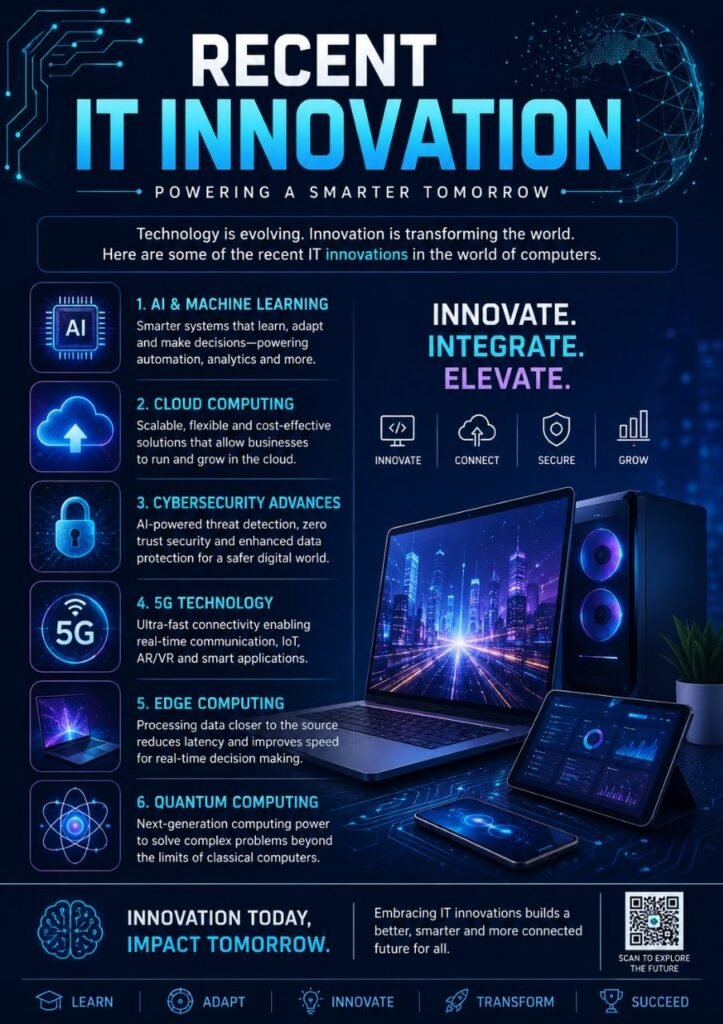
ComputerGS brings you the latest and most Recent IT Innovations of 2026 in easy language.
1. Artificial Intelligence (AI) Agents
Artificial Intelligence
AI Agents are intelligent software systems that can perform tasks automatically, make decisions, and learn from data without human help. In addition, these systems are improving rapidly due to advancements in machine learning.
Features | Recent IT Innovations
- Self-learning capability
- Smart automation
- Human-like interaction
- Fast decision making
Applications
- Chatbots
- Virtual assistants
- Online education
- Banking systems
Exam Point
This technology is widely used in automation and modern computing systems. As a result, many industries are adopting AI-based solutions.
2. Quantum Computing
Quantum Computing
This technology uses Qubits instead of normal binary bits. Unlike traditional computers, quantum computers can solve highly complex calculations much faster.
Advantages
- Faster processing
- Advanced scientific research
- Better cybersecurity
- Drug discovery
Major Companies Working
- IBM
- NVIDIA
Exam Point | Recent IT Innovations
Quantum computers use principles of quantum mechanics. Consequently, they are considered the future of advanced computing.
3. Edge Computing
Edge Computing
Edge Computing processes data near the device instead of sending everything to cloud servers. Therefore, it reduces delays and improves performance.
Benefits | Recent IT Innovations
- Low latency
- Faster response
- Better privacy
- Reduced internet load
Uses
- Smart cameras
- IoT devices
- Self-driving cars
Furthermore, edge computing helps improve real-time applications significantly.
4. AI-Powered Cybersecurity
Cybersecurity
Modern cybersecurity systems now use AI to detect and stop cyber attacks automatically. As cyber threats continue to increase, AI-based security systems are becoming more important.
Features | Recent IT Innovations
- Threat detection
- Malware analysis
- Real-time protection
- Fraud prevention
Importance
Furthermore, Cybersecurity protects computers, servers, and networks from digital attacks. Hence, organizations are investing heavily in advanced security technologies.
5. 6G Technology
6G
After 5G, scientists are developing 6G technology for ultra-fast internet communication. In fact, 6G is expected to revolutionize wireless connectivity.
Expected Features | Recent IT Innovations
- Very high internet speed
- Smart city support
- Hologram communication
- Better AI integration
Exam Point | Recent IT Innovations
6G is expected to be faster than 5G with near-zero latency. Thus, it may support future smart technologies efficiently.
6. Brain-Computer Interface (BCI)
Brain-Computer Interface
BCI allows direct communication between the human brain and computers. As a result, people with disabilities may benefit greatly from this technology.
Applications
- Medical treatment
- Disabled assistance
- Gaming technology
- Robotics
Future Scope | Recent IT Innovations
BCI may revolutionize healthcare and human-machine interaction. Additionally, researchers are exploring its use in education and communication.
7. Hyperautomation
Hyperautomation
Hyperautomation combines AI, robotics, and machine learning to automate business processes. Consequently, businesses can improve efficiency and reduce costs.
Benefits
- Saves time
- Reduces cost
- Improves productivity
- Increases efficiency
Besides this, hyperautomation minimizes human errors in repetitive tasks.
8. Augmented Reality and Virtual Reality
Augmented Reality
Virtual Reality
AR and VR technologies create immersive digital experiences. For example, VR headsets can create realistic virtual environments for users.
Uses
- Online education
- Gaming
- Medical training
- Virtual meetings
Example
These technologies are transforming digital learning and entertainment. Therefore, many companies are investing in AR and VR platforms.
9. Green Computing
Green Computing
Green Computing focuses on reducing energy consumption and electronic waste. In other words, it promotes environmentally friendly technology usage.
Objectives
- Eco-friendly devices
- Energy-efficient systems
- Sustainable data centers
- Reduced carbon emissions
Importance
It helps protect the environment while using technology efficiently. Hence, green computing is becoming a global priority.
10. Internet of Things (IoT)
Internet of Things
IoT connects smart devices through the internet for data sharing and automation. As technology advances, IoT devices are becoming more common in daily life.
Examples
- Smart homes
- Smart watches
- Smart vehicles
- Smart agriculture
Advantages
- Automation
- Real-time monitoring
- Better efficiency
Conclusion
Recent IT innovations are transforming the digital world rapidly. Technologies like Artificial Intelligence, Quantum Computing, 6G, IoT, and Cybersecurity are becoming essential in modern life and competitive examinations. Students should stay updated with these innovations to improve their computer awareness and general knowledge.
ComputerGS will continue providing updated technology notes, MCQs, and exam-oriented content for SSC, RRB, Banking, UPSC, and UPSSSC preparation.
Frequently Asked Questions (FAQs)
Which is the latest innovation in IT?
Artificial Intelligence Agents and Quantum Computing are among the latest innovations in IT.
What is Green Computing?
Green Computing is the practice of using environmentally friendly and energy-efficient computer systems.
What is the use of IoT?
IoT connects smart devices for automation and real-time data exchange.
Which technology may replace traditional computing?
Quantum Computing has the potential to revolutionize traditional computing systems.